Jigsaws
Are you bored? Don’t know what to do? There is always some pastime that keeps you entertained while also letting you learn something: books, films, comics, stamps and… Of course! How had I not thought of it before? Jigsaw puzzles!
A jigsaw puzzle is a good companion that will stay with you for life from the very first day you get it. Here I show you which puzzles I own. All of them are spread around the house to brighten it up and decorate it.
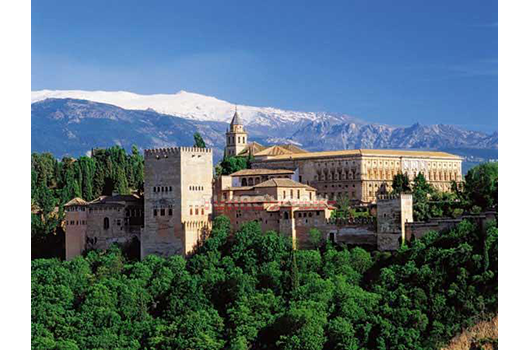
The Alhambra, Granada
The Alhambra, without a doubt, one of the oldest palatine cities…
The Alhambra, in geometric terms, is a great tribute to the square, its proportions and its stability. It points to the four elements, the four seasons, the four ages of life, the four cardinal points that bring order to the world.
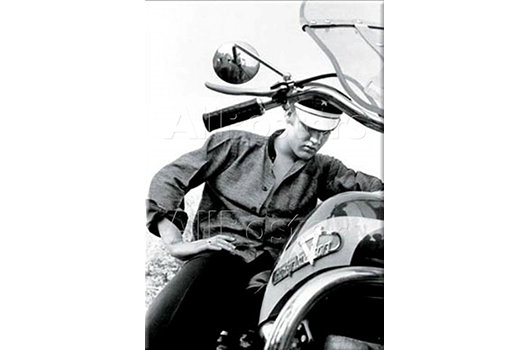
Elvis and his motorcycle (July 4, 1956)
The puzzle “Elvis on his Motorcycle” is based on a photograph by Alfred Wertheimer, RCA photographer, taken in Memphis in 1956 and titled “No gas in the tank”.
Elvis wonders why his Harley won’t start. He opens the tank and, to his great surprise, realizes there is no gas. One of his cousins goes to the nearest gas station and comes back with a half-full can. He pours it into the tank. The engine starts and Elvis goes off for a ride.
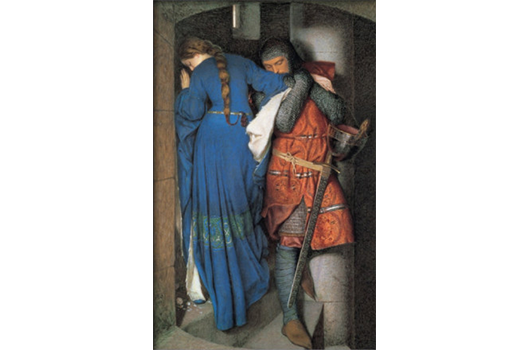
The Meeting on the Turret Stairs
“The Meeting on the Turret Stairs” is one of the best-known works by Sir Frederic William Burton, painted in 1864. The subject comes from a medieval Danish ballad describing how Hellelil falls in love with Hildebrand, Prince of England, one of her twelve personal guards. A story of impossible love.
Burton made a free interpretation of the story. The kiss on the woman’s outstretched arm and the lack of eye contact give the painting great intensity.
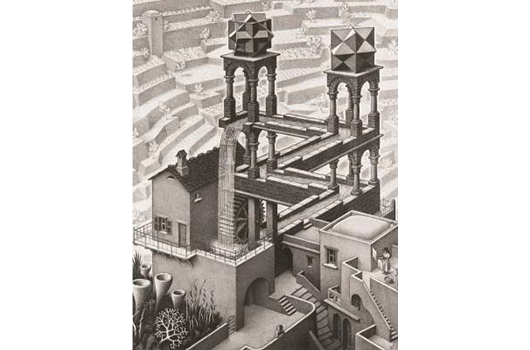
Waterfall
While most artists working in two dimensions use relative proportions to create an illusion of depth, Escher uses contradictory proportions to create a visual paradox.
“Waterfall” is built around a Penrose triangle, an impossible object created by Oscar Reutersvärd and independently rediscovered by the physicist Roger Penrose.
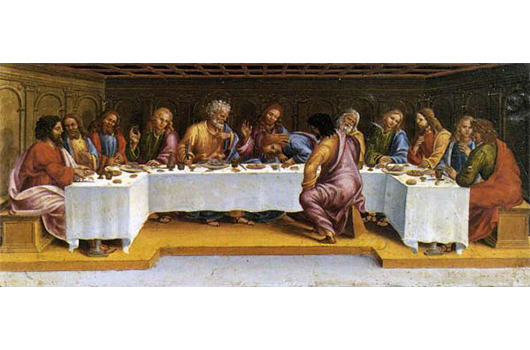
The Last Supper
This depiction of the Last Supper is a work by the Italian painter Luca Signorelli from the year 1502. There have been many representations of this Gospel episode, although the most famous is that of Leonardo da Vinci.
The original can be found in the Diocesan Museum of Cortona, the city where the artist was born.
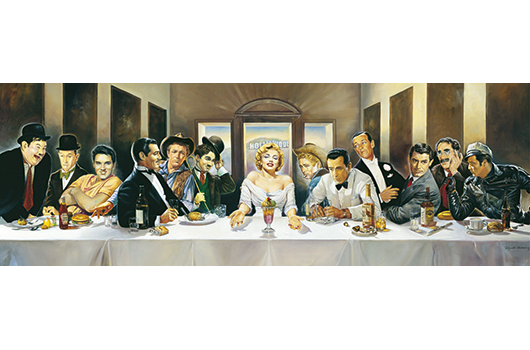
The dinner of the famous
Magnificent print by Renato Casaro imitating Leonardo da Vinci’s “The Last Supper” by replacing the original characters with famous figures from American cinema.
The 12 apostles are 12 great male Hollywood stars (from left to right): Stan Laurel, Oliver Hardy, Elvis Presley, Clark Gable, John Wayne, Charles Chaplin (Charlot), James Dean, Humphrey Bogart, Fred Astaire, Rock Hudson, Boris Karloff and Marlon Brando.
The central character, Jesus, is represented by the only woman in the group, the dazzling Marilyn Monroe.
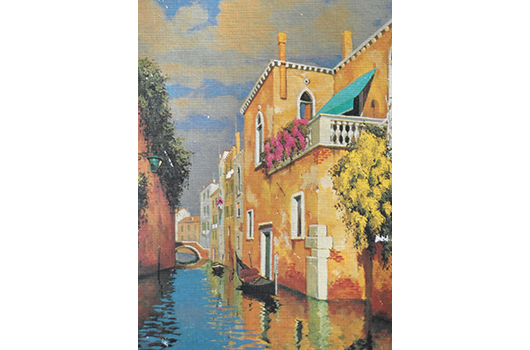
Romance in Venice
This is a puzzle from Educa’s miniature collection. It is based on an image created by the Italian print painter Lucio Sollazzi.
Sollazzi’s painting follows a range of influences, from the great English Romantics to the Dutch landscape painters of the 17th century. Lucio Sollazzi currently lives in Monte Carlo, and the Mediterranean and Venetian coasts provide much of the inspiration for his contemporary work. Sollazzi considers himself an optimistic painter and wants his paintings to reflect his own happiness.
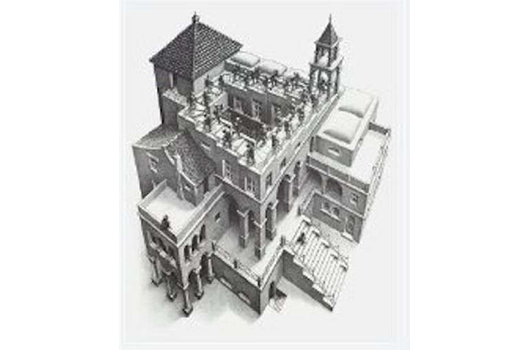
Ascending and Descending
While most artists working in two dimensions use relative proportions to create an illusion of depth, Escher uses contradictory proportions to create a visual paradox.
“Ascending and Descending” is one of the works the artist made in 1960, using ;lithography. The image shows a large building covered by an infinite staircase. There are two rows of identically dressed men: one row appears to be climbing the stairs while the other appears to be going down.
The trick behind the visual paradox lies in the Penrose stairs, which turn 90 degrees four times, giving the impression that they go up or down at the same time, regardless of direction.
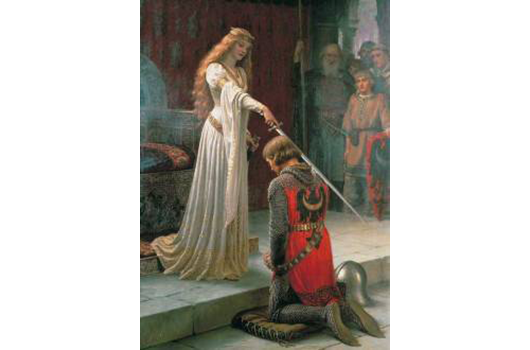
The Accolade
Edmund Blair Leighton (1853-1922), like many of his Pre-Raphaelite colleagues, had a fondness for medieval-inspired themes.
In “The Accolade“, painted in 1901, the British artist evokes a scene with Celtic overtones: a lady bestowing knighthood on a knight in an image that captures, with Leighton’s characteristic Romantic inspiration, all the flavour of Arthurian tales.
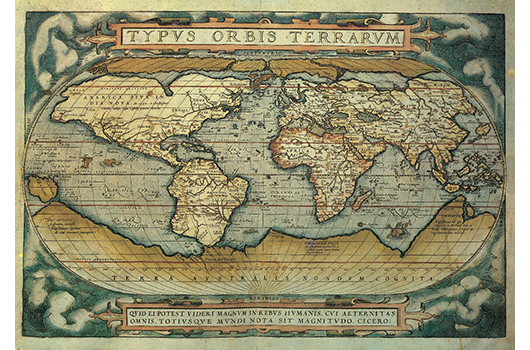
Planisphere
This planisphere, “Typus Orbis Terrarum”, comes from the atlas Theatrum Orbis Terrarum, created by the cartographer Abraham Ortelius (1527-1598) in the year 1570.
It is considered the first true atlas in history, as it was the first systematic and comprehensive collection of maps in a uniform style.
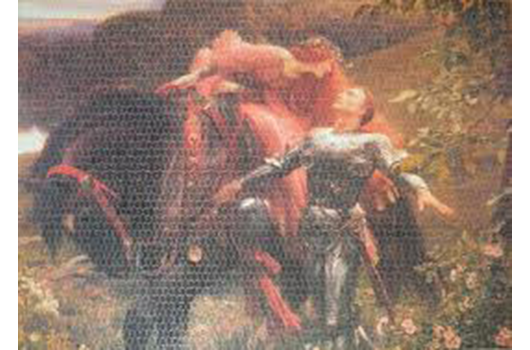
The Belle Dame without Mercy
La Belle Dame sans Merci (The Belle Dame without Mercy) is a ballad by the English poet John Keats (1795-1821), written in 1819 and inspired by a poem written by Alain Chartier in the 15th century.
The symbolism and sadness of the poem, together with its fatal lady, have made it hard to resist, inspiring many painters. The most popular versions are probably those by John William Waterhouse, Arthur Hughes, and also the later versions by Frank Cadogan Cowper and Sir Francis Bernard Dicksee. Walter Crane and Henry Maynell Rheam also created works inspired by the poem.
Sir Frank Bernard Dicksee (1853-1928) is one of the artists who treated epic and classical subjects in a Pre-Raphaelite style, although he never actually belonged to the Pre-Raphaelite Brotherhood. His version of La Belle Dame sans Merci dates from 1903.
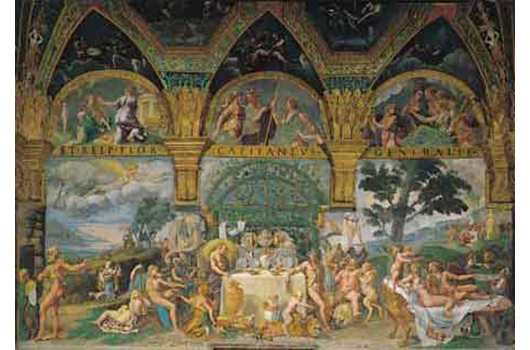
The wedding of Psyche and Cupid
Giulio Romano, the main disciple and collaborator of Raphael, demonstrated his talent by directing the construction and decoration of the Palazzo del Te in Mantua, his major work.
Among the walls of this palace, The wedding of Psyche and Cupid stands out, a fresco of splendid virtuosity in which, once again, the artist manages to surprise the viewer with his great skill and imagination.

| Manufacturer | EDUCA |
| Author | – |
| Year | 1998 |
| No. of pieces | 500 |

| Manufacturer | NATHAN |
| Author | Alfred Wertheimer |
| Year | 1997 |
| No. of pieces | 1000 |
| Manufacturer | EDUCA |
| Author | F. W. Burton |
| Year | 2003 |
| No. of pieces | 1000 |

| Manufacturer | SELEGIOCHI |
| Author | Maurits Cornelis Escher |
| Year | 1983 |
| No. of pieces | 1000 |
| Manufacturer | EDUCA |
| Author | Luca Signorelli |
| Year | 2001 |
| No. of pieces | 1000 |

| Manufacturer | SCHMIDT |
| Author | Renato Casaro |
| Year | 1997 |
| No. of pieces | 1000 |
| Manufacturer | EDUCA |
| Author | L. Sollazzi |
| Year | 1997 |
| No. of pieces | 1000 |
| Manufacturer | SELEGIOCHI |
| Author | Maurits Cornelis Escher |
| Year | 1983 |
| No. of pieces | 1000 |
| Manufacturer | EDUCA |
| Author | E. B. Leighton |
| Year | 1997 |
| No. of pieces | 2000 |
| Manufacturer | EDUCA |
| Author | Abraham Ortelius |
| Year | 1990 |
| No. of pieces | 3000 |
| Manufacturer | EDUCA |
| Author | Sir Frank Dicksee |
| Year | 2005 |
| No. of pieces | 3000 |
| Manufacturer | EDUCA |
| Author | Giulio Romano |
| Year | 1997 |
| No. of pieces | 5000 |